Our Top Course
English-International Conference on the Poetics and Politics of translation
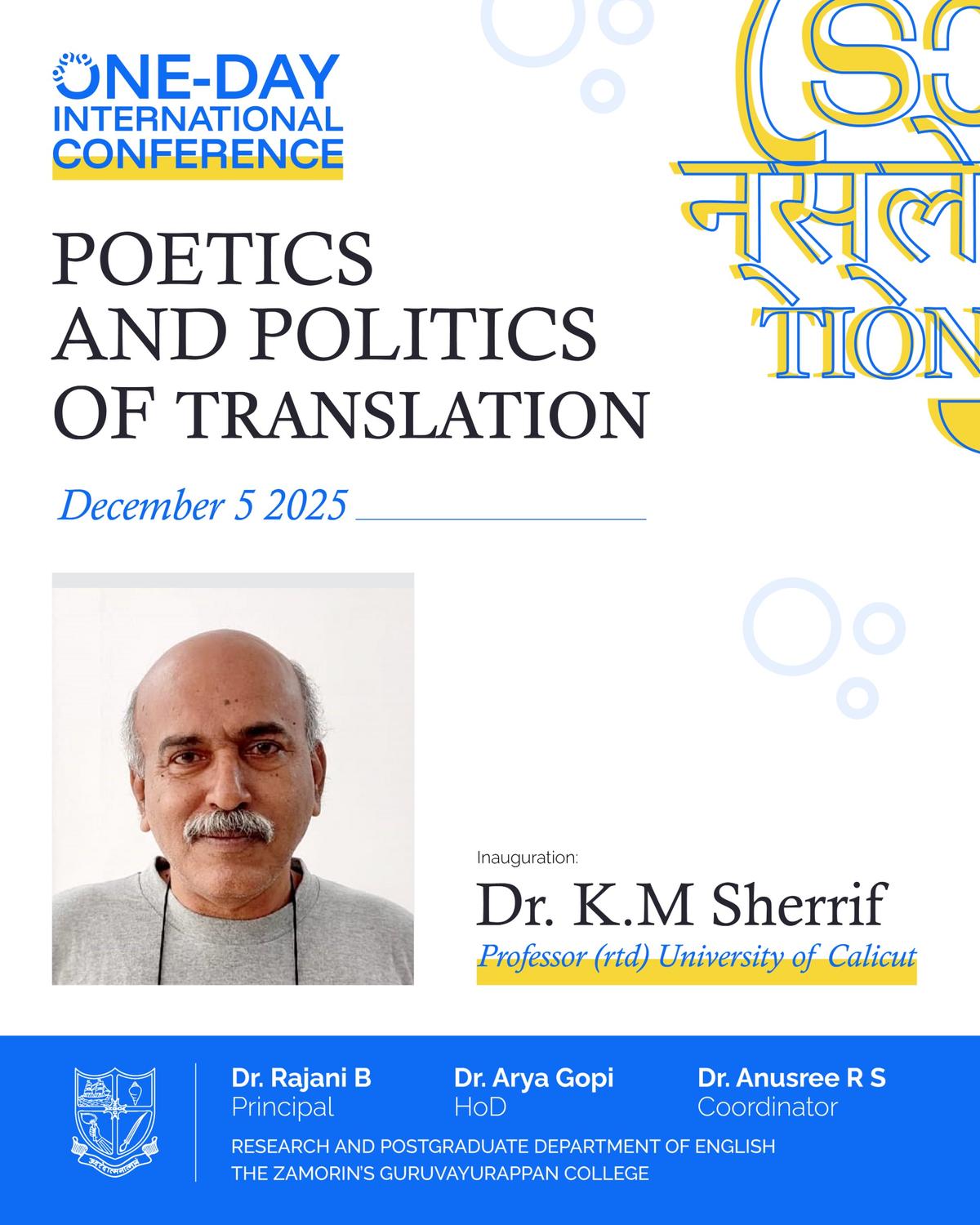
Report on the One-Day International
Conference on
Poetics and Politics of Translation**
5 December 2025
Research Centre – Seminar Hall
1. Introduction
The One-Day International Conference on “Poetics and Politics of Translation”, held on 5
December 2025 at the Research Centre–Seminar Hall, brought together scholars, researchers,
and students to explore translation as both an aesthetic and political act. The conference
aimed to foreground translation’s multifaceted role in shaping literary canons, cultural
memory, and global readership patterns.
2. Inaugural Session
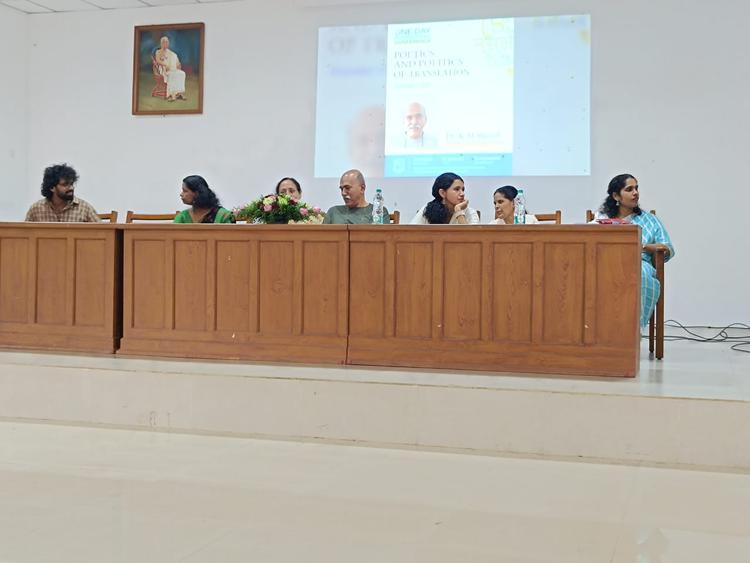
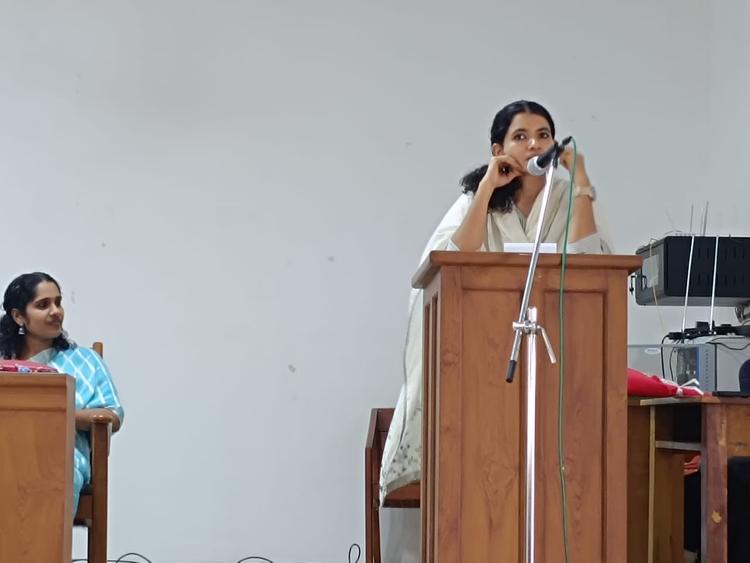
The event commenced with a prayer followed by the Welcome Address by Dr. Anusree R.
S., who highlighted the relevance of translation studies in today’s global academic landscape.
Dr. Anusree R. S. also emphasized that translation is never a neutral transfer of language but
a negotiation of culture, ideology, and power
Dr. Anargha P. (Head of the Department In-Charge) delivered the Presidential Address,
underscoring the department’s commitment to nurturing interdisciplinary scholarship.
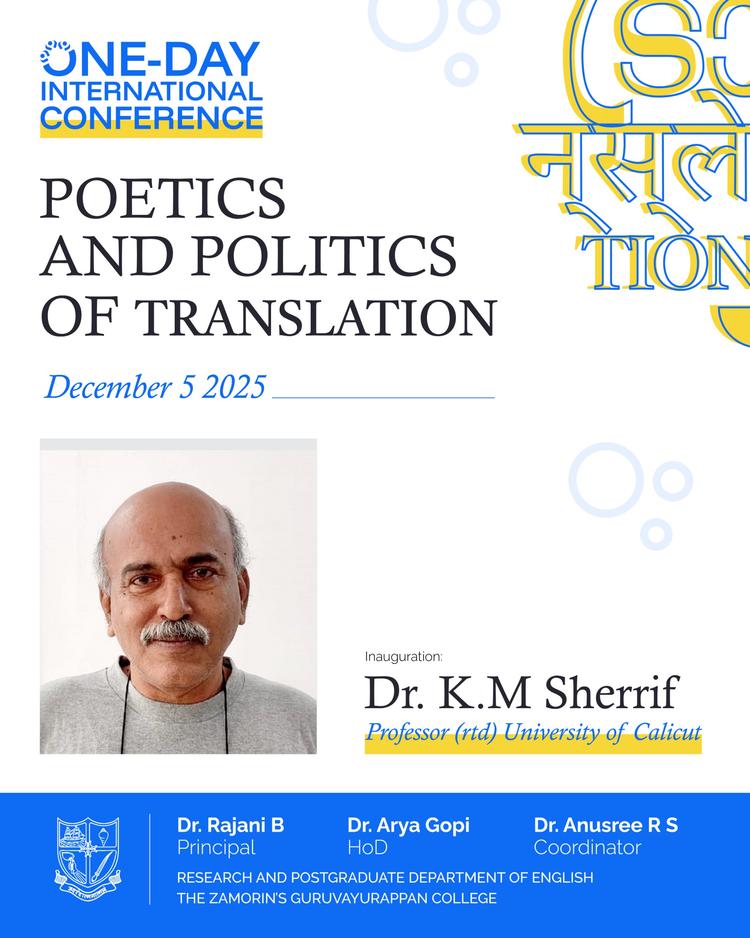
The conference was formally inaugurated by Dr. K. M. Sheriff, Professor (Retired),
Department of English, University of Calicut.
Felicitations were offered by:
Ms. Gangadevi P. C. (Member, College Governing Body)
Dr. Binu P. S., Associate Professor
Dr. Anagha B. K., Assistant Professor
Mr. Sreerag (Coordinator) delivered the Vote of Thanks, marking the formal conclusion of
the inaugural ceremony.
3. Plenary Session 1 (10:30 AM – 12:00 PM)
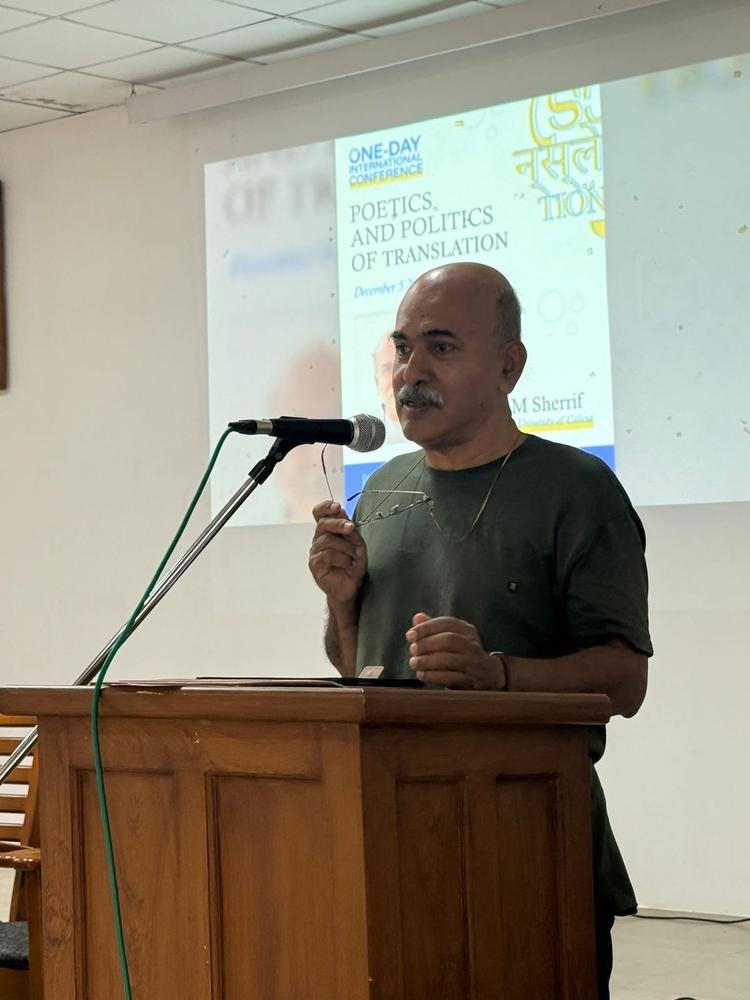
Speaker: Dr. K. M. Sheriff
Topic: Collaborative and Multilingual Translation
Dr. K. M. Sheriff delivered a profound session highlighting the shifting terrains of translation
in a multilingual world. He discussed multilingual, collaborative, and solitary modes of
translation, noting how each generates distinct interpretive and ethical tensions. He critiqued
the limitations of mainstream translation theory, arguing that it often fails to address real-
world cultural negotiations.
Using examples such as the King James Bible, and the translated works of Orhan Pamuk,
Milan Kundera, and Vladimir Nabokov, he demonstrated how translation reshapes
narrative tone, political nuance, and cultural identity. Dr. Sheriff also reflected on
contemporary translation practices, including rising digital tools, while emphasizing the
irreplaceable role of human translators in preserving nuance, context, and cultural
sensitivity.Mr. Aswin Vijayan (Assistant Professor, Dept of English) initiated a fruitful
discussion after the plenary. The discussion set a rigorous intellectual foundation for the day's
proceedings.
4. Paper Presentations (11:30 AM) – Digital Classroom
Chair: Ms. Neela P. U.
The paper presentation session showcased research contributions from undergraduate,
postgraduate, and research scholars, reflecting a broad engagement with translation’s cultural
and political dimensions.
1. Rifana Fathima T, II BA English
“From Kitchen Talk to Courtyard Talks: A Study Through Ram ℅ Anandhi (2020) &
Chemmeen (1956)”
The paper traced the shift of women’s voices from the domestic to the public sphere,
showing how translation and adaptation mediate gendered narratives across historical
periods.
2. Fathima Afna K, II BA English
“From Chinese Ballad to Western Gaze: Misrepresentation of Tradition in Disney’s
Mulan”
The study critiqued Disney’s adaptation of the Chinese Ballad, emphasizing how
Western translation frameworks distort indigenous cultural traditions.
3. Aneesha Fathima N. P, II BA English
“Euphemizing Stalking: Subtitling Desire and Gender Politics in Premam”
This presentation examined how subtitling choices normalize problematic male
behavior and influence interpretations of desire and gender power dynamics.
4. Firosa, II MA English
“Translation as Rewriting: A Political and Aesthetic Act in Sayaka Murata’s
Convenience Store Woman”
The paper highlighted translation as an inherently political act, exploring how cultural
contexts reshape character identity and sociocultural critique.
Lunch Break (12:30 PM)
5. Plenary Session 2 (1:30 PM – 2:30 PM)
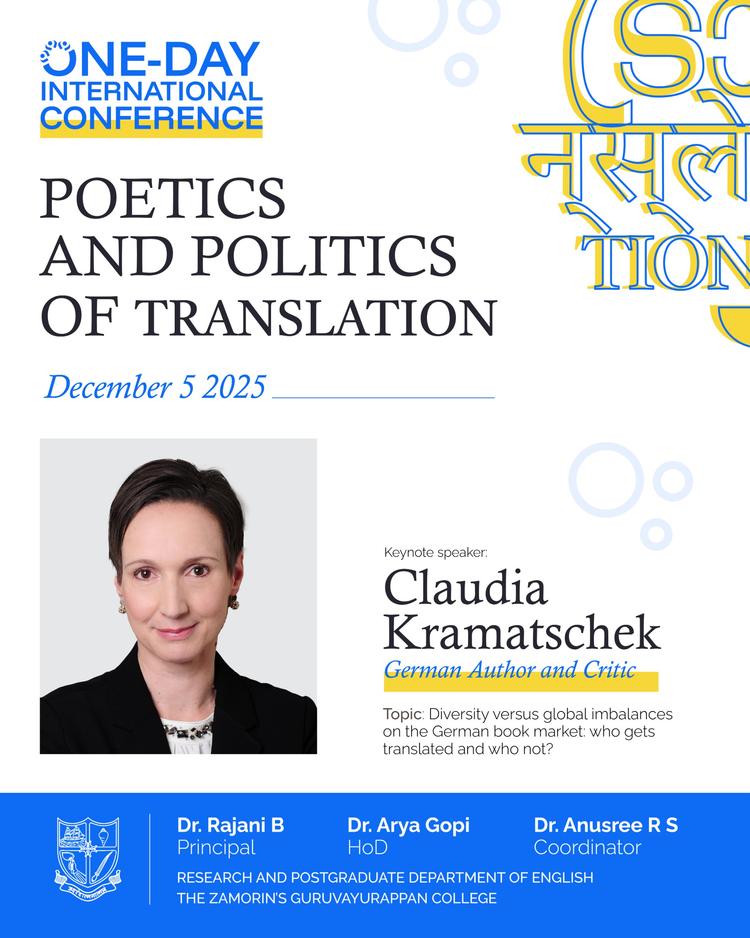
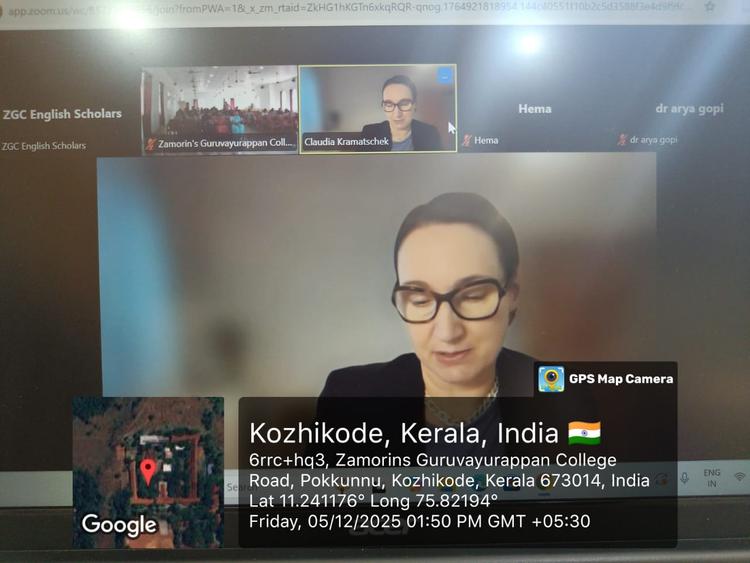
Speaker: Claudia Kramatschek (German Author and Critic)
Topic: Diversity versus Global Imbalances on the German Book Market: Who
Gets Translated and Who Not?
Moderator: Mr. Aswin Vijayan
The second plenary session was delivered by Claudia Kramatschek, who provided a global,
market-oriented perspective on translation and literary circulation. Drawing from her
experience with the Frankfurt Book Fair, she outlined how systemic inequalities shape
which authors and cultures gain international visibility.
She noted that around seven thousand books are produced in Germany each year, and
over eighty percent of these are translations. However, the majority come from Europe and
America, with very limited representation from Asia, Africa, and other Global South
nations, revealing stark global imbalances. Invoking Goethe, she emphasized the democratic
potential of translation by granting readers access to diverse literatures.
Kramatschek also highlighted the role of the digital ecosystem, which has expanded
publication volume and influenced reading practices. She stressed that readers are central to
the literary market, and that global demand often favours certain authors such as Salman
Rushdie and Arundhathi Roy illustrating how visibility is shaped by geopolitical and
cultural power structures. Her session offered a critical, data-driven view of translation as a
tool of cultural democracy and global literary justice. The students and teachers asked
questions to Ms. Claudia Kramatschek which helped to create a fruitful discussion after the
talk.
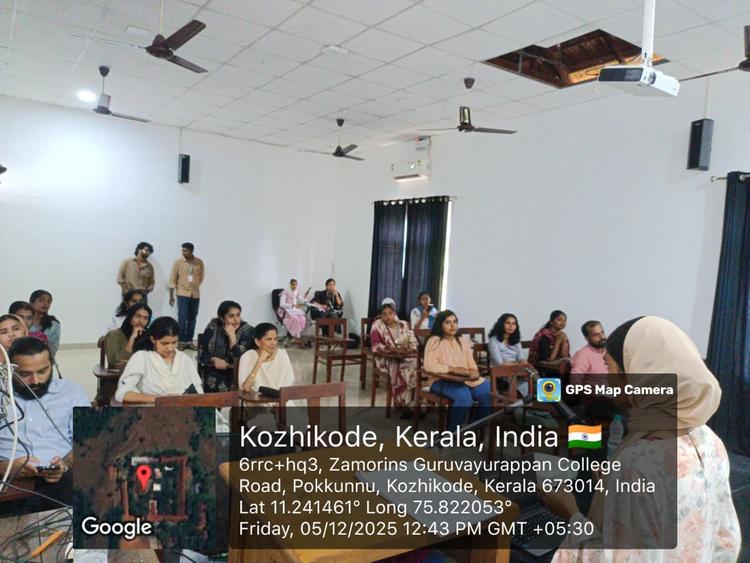
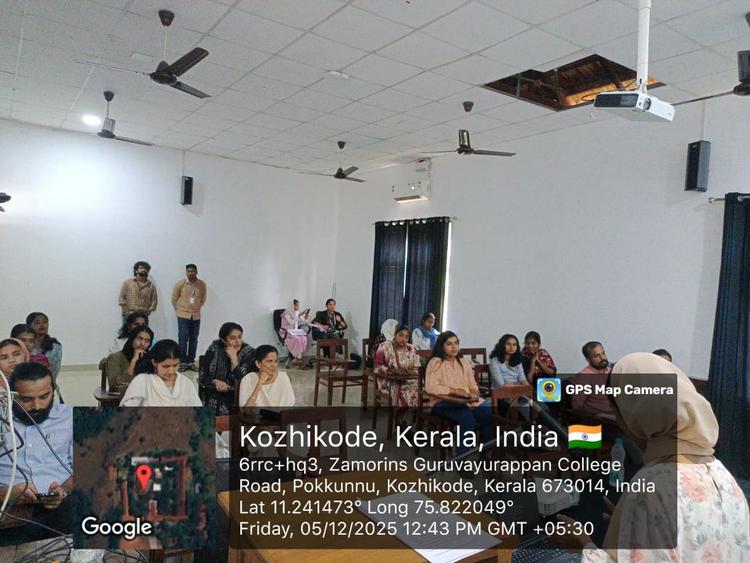
The conference witnessed enthusiastic participation from more than one hundred
students, alongside faculty members and research scholars. Their active engagement
enriched the discussions and demonstrated a rising academic interest in translation as both
theory and practice.
Session 2 – PG Seminar Hall
Chair: Dr. Jibin Baby
1. Anooja George K, Research Scholar
“Representation of Christian Identity and Culture in Selected Malayalam Movies”
The paper explored how Malayalam cinema translates Christian cultural identity into
visual narratives. The presenter examined how filmic storytelling negotiates themes of
faith, community, and regional expression.
2. Noufa Fathima P, II BA English
“Theyyam as a Translator of Subaltern Voices”
This study positioned Theyyam as a performative mode that translates marginalized
histories into public cultural memory. The presenter highlighted its role as a powerful
medium of subaltern assertion.
3. Anjana V. P, II BA English
“Media as Translator: Deconstructing Ophelia in the Era of Taylor Swift”
The presentation discussed how contemporary media reinterpret classical female
characters like Ophelia through modern cultural icons. By drawing connections to
Taylor Swift’s artistic persona, the paper underscored translation across time and
media.
4. Gayathri P. G, II BA English
“Yakshi as a Subaltern Voice: From Fear to Power/Empowerment”
The study traced the transformation of the Yakshi figure from a spectral, feared
presence to a symbol of feminine empowerment. The presenter argued that such
reinterpretations operate as cultural translations redefining gender and agency.
6. Major Outcomes
Translation was reaffirmed as a politically charged, culturally embedded practice.
Both plenary sessions highlighted global inequities in translation and the cultural
responsibility of translators.
Student presenters demonstrated how translation intersects with film, literature,
folklore, and media.
The conference encouraged deeper reflection on translation’s role in democratic
accessibility and cultural representation.
7. Conclusion
The One-Day International Conference on Poetics and Politics of Translation successfully
fostered rich academic dialogue and critical reflection. With insightful plenary talks and
thoughtful student research presentations, the event strengthened the institution’s research
culture and highlighted translation’s pivotal role in shaping global literary and cultural
landscapes. The organizers expressed hope that the conversations initiated here will inspire
further study and collaboration in translation studies.